

On July 1, China State Council Decree No. 837 came into effect.[1] It revamps China’s regime for regulating outward investment…
There’s No Market for Selling Branding Gaffes
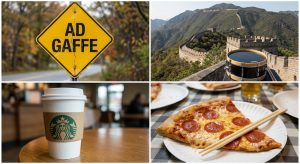
Recently, Lululemon, a Canadian clothing company specializing in, among other things, athletic and leisure wear, was stretched out to dry in China because of a promotional event held at China’s iconic Great Wall in July that featured a Japanese taiko drum![1] Yup, a Japanese drum. This would be sensitive at any time, but was destined to raise hackles given the current abysmal state of China-Japan relations. In neighboring South Korea, Starbucks Korea, a subsidiary of Shinsegae Group, was hammered two months earlier for an ad campaign that featured numerous elements and product items that directly or indirectly tied to an anti-democracy crackdown in 1980 and the murder seven years later of a pro-democracy activist.[2] The previous year Canada’s Arc’teryx, which is owned by Amer Sports which is majority owned by China’s Anta Sports, found itself under the spotlight for igniting a huge, as well as environmentally harmful, fireworks dragon in Tibet, sacred ground to some.[3] These gaffes were followed by multiple apologies and, in some cases, management changes, sensitivity training, and campaign terminations.
These fiascoes are incredible in and of themselves, but standout because they, at least in the case of China, come in the wake of numerous other high-profile marketing and sales blunders by foreign companies. In 2018, Italy’s Dolce & Gabbana, a luxury fashion business, disseminated three videos to promote an upcoming fashion show. The videos showed a woman struggling to eat Italian food with chopsticks and made fun of Chinese English-language pronunciation.[4] In February 2025, Fendi, an Italian fashion brand, got tied up in knots because of a handbag that had woven designs that were presented as coming from Korea, but Chinese audiences saw as Chinese.[5] More recently, Switzerland’s Swatch, a watchmaker, got wound up because of an advert in August 2025 which involved a male model pulling the corners of his eyes to feature “slanted eyes”![6]
There are, of course, many steps that companies can take to avoid these blunders. One obvious one is to make use of local staff or advertising firms who may, at least in concept, be more knowledgeable about local issues. Still, this is insufficient because local staff or advertising firms may not have the demographics, experience, or training that ensures adequate awareness of culture, history, or the contemporary domestic- and geo-political environments. Given this, it is highly desirable to include corporate legal, government affairs, and public relations staff among the teams developing large-scale campaigns, campaigns at iconic sites such as China’s Great Wall, and campaigns highlighting cultural elements.
Dealing with the contemporary political environments not only necessitates involving legal, government, and public affairs staff, but a need for “three awarenesses.” First, companies need to understand that working with local officials or local business partners may be insufficient as seen in the Arc’teryx case where various local officials, later punished or dismissed, approved the problematic fireworks show.[7] This was also shown in the Starbucks Korea case where the staff and managers involved in the flawed ad campaign were locals.[8] Such officials or local partners may be more focused on, respectively, generating economic returns for their provinces, cities, or smaller political units or their firms and may insufficiently appreciate the broader political milieu. As for local officials, it is entirely possible they may not grasp the fact that social media has dramatically expanded the audience that observes ad campaigns and can make campaign gaffes far more political than the initial facts might merit. Regarding local partners, they are hardly immune from their own ad blunders.[9] Second, marketing and sales staff need political training. Indeed, something as simple as reviewing “Today in history this happened…” could be useful. Third, there need to be regular communications between headquarters and local operations because the former may be ignorant of the local while the local may be inattentive to the brand as it strives to produce provocative ads to meet its operating unit targets. Moreover, the local may be inattentive to the fact that tailoring ads to fit local requirements can spur a backlash in home countries and elsewhere.[10]
It may be tempting to treat advertising campaign blunders on the fly rather than make structural adjustments. After all, consumer boycotts often do not happen or fade out and host countries act to temper local anger in the name of preserving investment and jobs. Moreover, some consumers seem forgiving, viewing corporate ad gaffes as evidence of ignorance or incompetence rather than nefarious intensions.[11] This would be a mistake given the millions and perhaps tens or hundreds of millions of dollars in revenue at stake. Moreover, the market in China and elsewhere is intensely competitive with competitors eager to exploit openings to win favor with consumers, build relations with government officials, and expand their operations overseas. Companies must up their ad game structures now to avoid becoming fair game.
[1] Joanna Patridge, “Lululemon apologises after Japanese drum row at Great Wall yoga event,” The Guardian, June 17, 2026, https://www.theguardian.com/media/2026/jun/17/lululemon-apologises-japanese-drum-great-wall-china-yoga-event.
[2] Philippe Mesmer, “South Korean Starbucks branch sparks outrage with references to historic massacre,” Le Monde, May 23, 2026, https://www.lemonde.fr/en/international/article/2026/05/23/south-korean-starbucks-branch-sparks-outrage-with-references-to-historic-massacre_6753749_4.html.
[3] Osmond Chia, “Outdoor brand Arc’teryx apologises for ‘dragon’ fireworks in Himalayas,” BBC News, September 22, 2025, https://www.bbc.com/news/articles/c1eddw19042o.
[4] Yuhan Xu, “Dolce & Gabbana ad (with Chopsticks) provokes public outrage in China,” NPR, December 1, 2018, https://www.npr.org/sections/goatsandsoda/2018/12/01/671891818/dolce-gabbana-ad-with-chopsticks-provokes-public-outrage-in-china.
[5] Chen Xi and Sun Langchen, “Fendi removes posts amid controversy over ‘incorrect description’ of bag design resembling Chinese knot,” Global Times, February 27, 2025, https://www.globaltimes.cn/page/202502/1329185.shtml.
[6] Kohn Ewe, “Swatch sorry for ‘slanted eyes’ ad after China uproar,” BBC, August 18, 2025, https://www.bbc.com/news/articles/cn02k9ykej5o.
[7] Xinlu Liang, “China punishes officials over fireworks publicity stunt in ecologically fragile Tibet plateau,” South China Morning Post, October 15, 2025, https://www.scmp.com/news/china/politics/article/3329149/heads-roll-china-over-fireworks-publicity-stunt-ecologically-fragile-tibet-plateau.
[8] Heekyong Yang and Heejin Kim, “Starbucks sees sharp drop in Korean sales after ‘Tank Day’ marketing backlash,” Reuters, May 25, 2026, https://www.reuters.com/world/asia-pacific/shinsegae-chairman-makes-public-apology-amid-backlash-over-starbucks-korea-2026-05-26.
[9] “Chinese phone brand’s Mother’s Day ad sparks backlash over ‘fan-circle,’ language,” Global Times, May 12, 2026, https://www.globaltimes.cn/page/202605/1360826.shtml.
[10] Thom Weidlich, “Brands’ China gaffes lead to groveling apologies,” PRCG Haggerty, February 15, 2018, https://prcg.com/blog/brands-china-gaffes-lead-groveling-apologies.
[11] Steven Borowiec, “Starbucks Korea faces boycott after ‘Tank Day’ mug promotion backfires,” Nikkei Asia, May 20, 2026, https://asia.nikkei.com/business/food-beverage/starbucks-korea-faces-boycott-after-tank-day-mug-promotion-backfires.


